We hear the catamaran vs monohull question constantly and extend this topic first talked about in our yacht charter guide blog post that gives you a general overview about the whole process. And we’re not just writing this from an office where no water is to be seen for miles and miles. We work with charter fleet operators in marinas, we see which boats come back with happy guests and which ones come back with stories about someone’s uncle who “never wants to sail again.”
So whether this is your first bareboat charter or you’ve done twenty weeks on monohulls and wonder what all the catamaran hype is about, here’s what actually matters when making this choice.
Quick answer? Both are excellent, but they’re excellent at different things. The right choice depends on who’s coming with you, what kind of sailing you want to do, and honestly how you want to feel like at the end of each day.
Here’s everything we know about catamaran vs monohull sailing after years of watching charter guests make this decision, sometimes brilliantly, sometimes not.
The Charter Market Can’t Really Decide Either
Before we get into the details, here’s something most comparison articles won’t tell you: catamarans and monohulls are fighting for number one every year in the sailing charter market. In 2024, catamarans won in booked sailing weeks, but during the 2025 season, the monohull is first after sitting second for years.
That shows that neither catamarans or monohulls are objectively better. So let’s figure out which side of that split makes sense for your crew during your yacht charter holiday.
Is a Catamaran Better Than a Monohull?
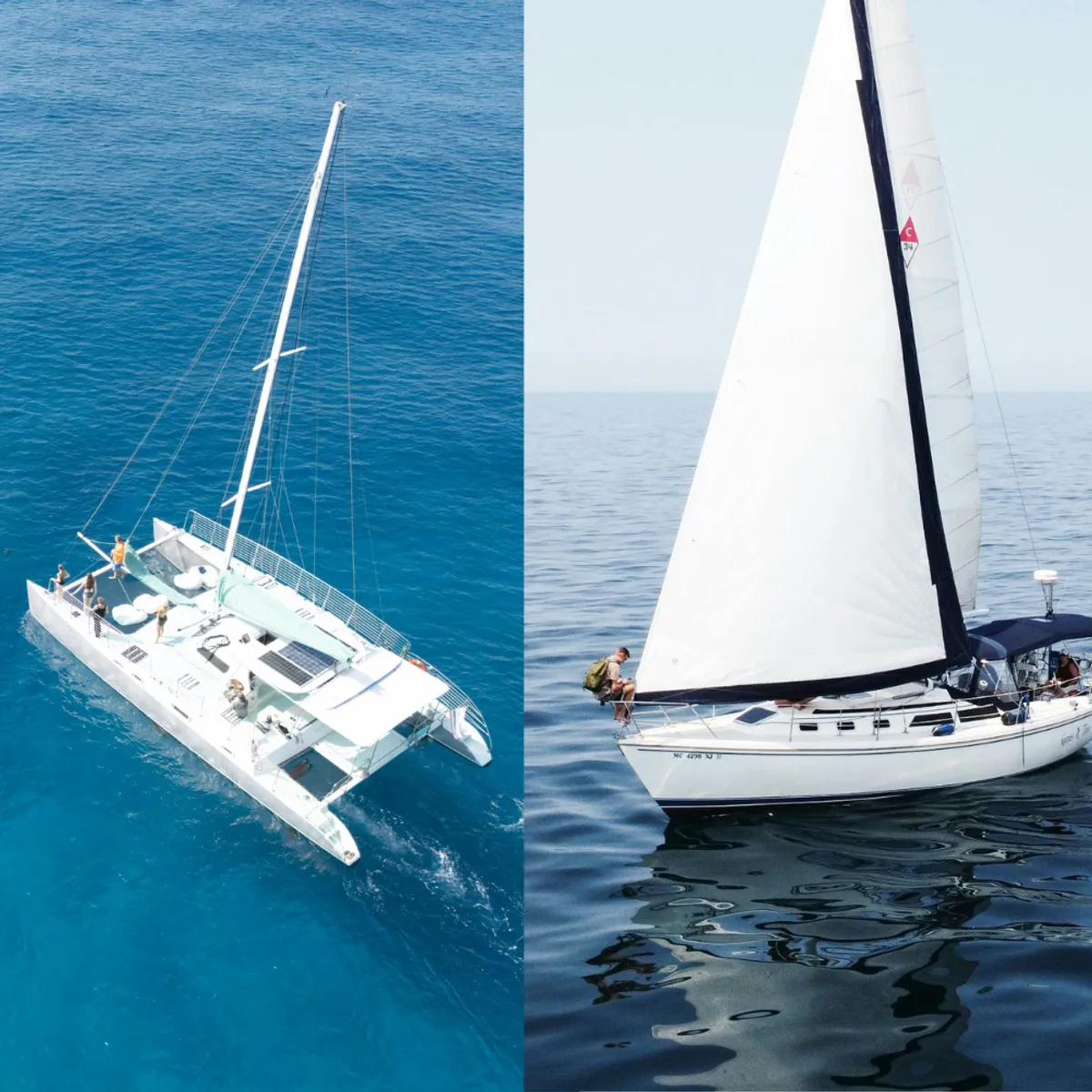
Catamarans win at comfort and stability, no question. The twin hull design creates this wide, stable platform that barely rolls, your drink stays upright, nobody is tripping and holding on to the handrails while trying to make lunch, even when there’s some waves. For families, groups of friends, or anyone who might feel sick fast on boats, sailing a catamaran removes most of the physical challenges that can turn a dream holiday into an endurance test.
A monohull sailboat wins when the sailing itself is the point. Monohulls point higher upwind, tack faster, respond to trim adjustments in ways you can actually feel, and give experienced sailors that connected, responsive experience many consider the whole reason to be out there in the first place.
Tim Geisler, lead instructor at Nautilus Sailing who runs courses in the Caribbean, put it bluntly to Yachting World: “Don’t even think about chartering a monohull in most of the Caribbean.” That’s not because monohulls are bad, it’s because the conditions and the typical charter guest priorities in that region favor cats so heavily that going monohull often means fighting an uphill battle for no real benefit.
But Croatia? Greece? Different story, different conditions, different dynamics.
Space and Living Comfort
Catamarans win this category.
A 40-foot catamaran gives you living space comparable to a 50-foot monohull. The wide beam means expansive salons with views everywhere, cockpits where eight people can actually eat dinner together without elbowing each other, and cabins that feel like actual rooms rather than closets.
Everything sits on one level too, which sounds minor until you’ve tried carrying hot coffee up companionway stairs while the boat moves with the waves. On a catamaran you just walk from the galley to the cockpit like a normal human being. Also, if any drama comes up, you physically have more space to get away from it… Just saying as we have seen breakups as well.
Monohulls have a cozier, more traditional feel. For couples or small crews who actually prefer that intimate, classic yacht atmosphere, a monohull feels right. There’s something to be said for the snug, protected feeling of being tucked below deck in a well designed monohull. It just comes with less total square footage.
Is a Catamaran Better in Rough Seas?
This depends entirely on what kind of rough and what you mean by better.
In moderate conditions, catamaran vs monohull stability isn’t even a contest. The level platform means less crew fatigue, dramatically less seasickness, and actually getting decent sleep during overnight passages. Experienced offshore sailors have noted that a squall that would have a monohull crew gripping the helm might not even wake passengers sleeping below on a catamaran.
But here’s what the brochures don’t emphasize: when you’re beating upwind in choppy conditions, the bridgedeck between a catamaran’s hulls slaps against the waves. This creates a sometimes annoying, repetitive noise and motion that wears on you. Experienced catamaran sailors know how to ease this off and sail a wider angle rather than pointing as high as a monohull would.
Monohulls handle upwind work in rough conditions more gracefully. The deep keel cuts through waves instead of riding over them. For passages involving serious upwind miles? Monohulls have a genuine advantage.
Do Catamarans Capsize Easier Than Monohulls?
This question comes up constantly, and it’s one of the most misunderstood parts of the whole catamaran vs. monohull debate.
Are catamarans safe? Yes. Modern cruising catamarans are extremely difficult to capsize according to Nigel Irens (if you don’t know him, he is an award winning boat designer). Their wide beam provides massive initial stability. Seeing the tests, you’d need sustained storm force winds combined with significant wave action to flip a properly sailed catamaran. The designs have evolved enormously from the lightweight racing multihulls that gave cats their reputation for being tippy.
In practice, for charter sailing in reasonable weather conditions, neither a monohull or catamaran is likely to capsize. Both boat types have logged hundreds of thousands of safe charter miles, capsizing is simply not something to worry about unless you’re planning to sail through hurricanes, which your charter company won’t let you do anyway.
What Is the Disadvantage of a Catamaran?
Catamarans have real tradeoffs worth knowing about before you book.
Cost is the obvious one. Charter rates for catamarans run 20 to 35 percent higher than similarly sized monohulls, sometimes more. Marina fees are higher too because cats require wider berths. In crowded Mediterranean ports during high season, finding an available slip for your catamaran can require booking well ahead. Try showing up in Hvar in August without a reservation, and you’ll understand why some experienced Med sailors stick with monohulls purely for logistics.
The motion at anchor can be strange too. Cats have this quick, snappy roll in beam swell that differs from the slower, deeper roll of a monohull, some people find it more annoying, others barely notice.
And honestly? Some sailors just think catamarans look ugly. This is completely subjective but entirely valid. You’re spending a week looking at and living on this boat. Ff you find catamarans aesthetically unappealing, that affects your enjoyment and there’s nothing wrong with choosing a pretty boat.
Catamaran vs Monohull Speed: Which Is Faster?
Depends on the conditions.
Monohulls often perform better in light air and when pointing high upwind. Their deeper hull forms and weighted keels give them momentum to carry through lulls and ability to sail closer to the wind.
For typical charter sailing where you’re not racing anyone, both will get you where you’re going at pleasant speeds. The cat might arrive a bit sooner downwind due to reduced drag in the water, the monohull when you have to sail upwind in more wavy conditions.
Innovations in Yacht and Hull Design
In the last years, technology and innovations created new opportunities to play with. New materials, shapes and operations have adapted to the different needs of charter guests around the world. For one, we have a more relaxed and smooth way of checking-in and use a digital guest app, on the other side, we get more variety on boat types.
Lets see what is currently happening on the yacht charter market in terms of boat design innovations.
What About Trimarans for a Yacht Charter?
Here’s something most catamaran vs monohull guides entirely ignore: you can now charter trimarans.
The new NEEL trimarans are available for bareboat charter starting around €4,400 per week in destinations including the Caribbean, French Riviera, and Balearics. The NEEL 43 and NEEL 47 offer an interesting middle ground. They sail more like performance boats than typical cruising cats but provide more stability than monohulls.
Trimarans heel only about 5 to 10 degrees versus 20 to 35 degrees for typical monohulls, meaning safer, more level decks without the sometimes weird motion cats can have at anchor. Often trimarans have an additional bed in the sides.
It is definitely worth considering to charter a trimaran for your next holiday if you want something different, particularly if your crew includes experienced sailors who want performance but family members who need stability.
The Eco Option: Hybrid Electric Catamarans
Another development that is now emerging more and more. You can now charter hybrid electric catamarans.
Windelo builds catamarans using basalt fiber made from volcanic rock and foam cores from recycled plastic bottles, partnering with French materials researchers at Mines d’Alès. Their hybrid electric system provides up to four hours of fully electric motoring per day at 6 knots, with solar panels and hydro generation keeping the batteries topped up while sailing.
The Windelo 54 won a Special Recognition Award at the 2025 Cruising World Boat of the Year awards, and Windelo cats are already available for charter in Corsica and the French Riviera.
If environmental impact matters to you, or you just want to experience what modern sailing yacht technology can do, this is genuinely interesting stuff. Motoring in near silence, no diesel fumes, the ability to anchor in pristine bays without worrying about generator noise, it changes the experience.
New Catamarans Coming in 2026
The catamaran market is exploding right now. According to Katamarans.com, 2026 is shaping up to be one of the most active years for new cat launches in a decade.
Fountaine Pajot is releasing five new models in a single year, the FP41, FP44, FP48, FP55, and a 70 footer. Nautitech’s new 41 Type S is positioned as a lighter, sportier option that will “sail better than most 40 to 42 foot cruising cats” while still offering comfort. Windelo is expanding with new 58 and 62 foot models with hybrid electric systems.
Performance cruising cats from builders like Outremer are even entering the crewed charter market, meaning you can experience what a proper bluewater performance catamaran feels like without buying one.
What this means for charter guests: more options, newer boats, and continued improvement. The stereotype of cats as floating apartments that barely sail is becoming increasingly outdated as builders respond to demand from owners who want both comfort and performance.
Which Should You Choose for Your Charter?
Let’s quickly break this down with a bullet point list highlighting everything organized and fast to understand.
Choose a Catamaran If:
Choose a catamaran if you want maximum space and comfort as well as:
- Have a mixed experience crew where some people have never sailed
- Have anyone in your group who is prone to seasickness
- Access to shallow anchorages and protected bays
- To charter in the Caribbean where cats dominate for good reason
- Want a relaxed social environment where you can escape drama
Choose a Monohull If:
You want that traditional sailing experience where the boat responds to wind and trim and you can feel what it’s doing and:
- You have an experienced crew who values actual sailing over floating around
- Need better upwind performance matters for your planned route
- You want lower charter rates and easier marina logistics
Or you just find the aesthetics and feel of a classic monohull more appealing.
Making This Decision Easier
If this is your first charter, think hard about who’s coming. Groups with non sailors or anyone sensitive to motion will have a dramatically better experience on a catamaran. Couples or small crews of experienced sailors who genuinely want to sail often prefer monohulls.
Think about your destination too. Caribbean with its consistent winds and countless shallow anchorages? Catamarans fit perfectly. The industry there has essentially standardized around them. Greek islands with their mix of conditions and sometimes tight harbors? Either works, depends on your priorities. Croatia, with its Bora wind and well equipped marinas? Great monohull territory if that’s what you prefer.
But honestly, just think about what you want from the trip. Is sailing the primary activity, do you want to cover distance and feel the boat work? Or is sailing mostly how you get between swimming spots and sunset anchorages while the real point is relaxing with good food and drinks that stay in the glass?
Modern charter companies provide detailed specs and digital yacht inventories so you can see exactly what equipment and space you’ll have before you arrive. Some companies, including those using Floatist, even let you complete paperwork and do pre arrival briefings digitally so you spend less time at the base and more time on the water. The right boat and charter company matched to your crew makes the difference between a good charter and a great one.
Frequently Asked Questions
The most asked questions we hear when talking about catamarans vs. monohulls.
What Is the Main Difference Between a Catamaran and Monohull?
A catamaran has two hulls connected by a bridgedeck, providing stability and space. A monohull has a single hull with a weighted keel for stability. Catamarans sail flat while monohulls heel under sail.
Is a Catamaran or Monohull Better for Seasickness?
Catamarans, significantly. They stay level and have gentler motion overall. The stable platform reduces the rolling that triggers motion sickness in most people. If anyone in your crew has seasickness concerns, this alone might make your decision.
Why Are Catamarans More Expensive To Charter?
They cost more to build due to their size and twin engine systems, they require larger marina berths which increases operating costs, and high demand for the comfort and space drives pricing up.
Can Beginners Charter a Catamaran?
Yes, catamarans are often recommended for first-time charterers because they’re more stable and in many ways easier to handle. Many charter companies offer optional skippers. If you want extra confidence, look for crewed charter options in your destination.
Catamaran vs Monohull Speed: Which Is Faster?
Catamarans are typically faster in downwind conditions, monohulls often perform better when pointing high upwind. For typical charter sailing, neither difference is dramatic enough to matter much.
Can I charter a trimaran?
Yes, NEEL trimarans are now available for bareboat charter in the Caribbean, French Riviera, and Balearics. They offer an interesting middle ground between catamaran comfort and monohull sailing feel.